Christmas party tax, staff gifts and travel expenses: what employers need to know in 2026
At a glance
Article summary
HMRC is running free live webinars for employers on trivial benefits, travel expenses, and social functions and parties. A staff Christmas party is free of tax and National Insurance if it is annual, open to all employees and costs £150 or less per head, while a non-cash staff gift of £50 or less can qualify as a trivial benefit. The tax-free mileage rate for cars and vans has risen to 55p for 2026 to 2027, and benefits reporting starts moving into payroll from April 2027.
HM Revenue and Customs (HMRC) has emailed employers inviting them to three free live webinars. They cover staff gifts, travel expenses, and social functions and parties. The timing is deliberate. Employers start planning end-of-year gifts and Christmas parties in the autumn, and small mistakes here create tax and National Insurance bills that nobody budgeted for.
For bookkeepers, payroll professionals, and the employers they support, this is also a good moment to check what has changed in 2026. The tax-free mileage rate has risen for the first time since 2011. HMRC has asked for evidence on how PAYE Settlement Agreements work. The way employers report benefits is also about to move into payroll.
This article explains the Christmas party tax rules, the £50 limit for staff gifts, the new travel rates and what to do when an exemption does not apply.
The short answer: A staff Christmas party is free of tax and National Insurance if it is an annual event, open to all employees (or all employees at one location), and costs £150 or less per head. That figure includes VAT, transport, and accommodation. A staff gift is tax-free if it costs £50 or less, is not cash or a cash voucher, and is not a reward for work.
What HMRC's email to employers covers
The email promotes three live HMRC webinars:
- Trivial benefits: what a trivial benefit is, the conditions for exemption, example scenarios, employer responsibilities and record keeping.
- Travel: travel and subsistence payments, mileage payments for employees who use their own vehicle, benchmark and bespoke scale rates, and reporting to HMRC.
- Social functions and parties: the conditions for an event to be exempt, what to do if it is not exempt, and PAYE Settlement Agreements.
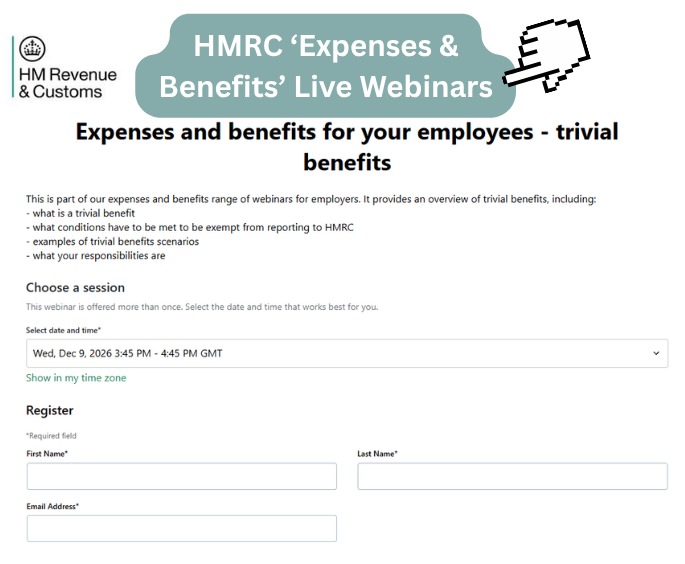
You can ask questions during each session using an on-screen text box. HMRC also points employers to a playlist of short videos on PAYE Settlement Agreements on its YouTube channel.
Every session is listed on HMRC's own page of email updates, videos and webinars for employing people on GOV.UK.
Christmas party tax: the £150 annual event exemption
The rules for staff parties are set out in section 264 of the Income Tax (Earnings and Pensions) Act 2003. HMRC explains them in its guide to social functions and parties.
An event is exempt from tax, National Insurance and reporting when it:
- is annual, such as a Christmas party or summer barbecue
- is open to all your employees, or to all employees at one location
- costs £150 or less per person
The exemption also applies to online or virtual parties. You can hold separate parties for different departments, if every employee can attend one of them.
How to work out the cost per head
The cost per head is the total cost of the event divided by the number of people who attend. Under section 264, the total cost includes:
- the party itself, such as the venue, food, drink and entertainment
- any transport or accommodation provided for people attending
- VAT, even if the business can reclaim it
Everyone who attends counts in the calculation, including guests who are not employees.
Worked example: a 40-person Christmas party
| Cost item | Amount (including VAT) |
|---|---|
| Venue, meal and drinks | £4,600 |
| Entertainment | £400 |
| Taxis home | £400 |
| Total cost | £5,400 |
| People attending (30 staff and 10 guests) | 40 |
| Cost per head | £135 |
At £135 per head, the party is exempt. Now suppose the employer adds a £1,000 drinks package. The total rises to £6,400 and the cost per head becomes £160. The whole £160 per head is now taxable, not just the £10 above the limit.
The £150 limit is not an allowance
People often call this the Christmas party allowance, but that name is misleading. The £150 figure is a threshold. If the cost per head goes over £150, even by £1, HMRC treats the full cost as a taxable benefit.
If the cost per head goes over £150, even by £1, HMRC treats the full cost as a taxable benefit.
In that case the employer must report the cost on each employee's form P11D and pay Class 1A National Insurance on the full cost. The alternative is to include the event in a PAYE Settlement Agreement, which is explained below.
Two or more events in the same tax year
The £150 limit covers all annual events in the tax year combined. Suppose you hold a summer barbecue costing £60 per head and a Christmas party costing £100 per head. The total is £160, so both cannot be exempt.
You can choose to treat the £100 Christmas party as exempt. The £60 barbecue then becomes a taxable benefit for everyone who attended it.
Events that do not qualify
A party for directors or senior managers only is not open to all employees, so it does not qualify. A one-off event that is not annual, such as a celebration for winning a contract, does not qualify either. These costs are taxable benefits for the people who attend, unless another exemption applies or you include them in a PAYE Settlement Agreement.
Staff Christmas gifts and the £50 trivial benefits rule
Many employers give staff a small gift at Christmas. HMRC treats a gift as a trivial benefit if all of these conditions apply:
- it cost £50 or less to provide
- it is not cash or a cash voucher
- it is not a reward for work or performance
- it is not part of the employee's contract

When all four conditions are met, you do not pay tax or National Insurance, and you do not need to tell HMRC. A turkey, a bottle of wine or a hamper costing £50 or less are typical examples.
There is no limit on the number of trivial benefits most employees can receive in a year. Directors of close companies are the exception. A close company is a limited company run by five or fewer shareholders. Its directors cannot receive trivial benefits worth more than £300 in a tax year.
Two points often cause problems. First, cash and vouchers that can be exchanged for cash never qualify, however small the amount. Second, a gift linked to targets or performance is a reward for work, so the exemption does not apply. Give the same festive gift to every employee, whatever their performance, and record why it was given.
Trivial benefits provided through a salary sacrifice arrangement are not exempt. For the business, gifts to employees are normally a deductible expense. The exception is where they are incidental to gifts to other people (HMRC Business Income Manual, BIM45065).
Travel expenses and the new 55p mileage rate
HMRC's travel webinar covers travel and subsistence, mileage payments and scale rates. The biggest change for 2026 is the mileage rate.
Approved mileage rates for 2026 to 2027
Approved mileage allowance payments are the amounts you can pay employees, free of tax, when they use their own vehicle for business journeys. On 21 May 2026, the government increased the rate for cars and vans from 45p to 55p per mile for the first 10,000 business miles.
This is the first increase since 2011. It applies from 6 April 2026, so it covers the whole 2026 to 2027 tax year. The change became law through the Taxation (Energy and Vehicles) Act 2026, which received Royal Assent on 15 July 2026 (House of Commons Library).
| Vehicle | First 10,000 business miles | Each business mile over 10,000 |
|---|---|---|
| Cars and vans | 55p | 25p |
| Motorcycles | 24p | 24p |
| Bicycles | 20p | 20p |
Source: HMRC travel, mileage and fuel rates. Employers can also pay 5p per mile for each fellow employee carried as a passenger on a work journey.
The amount that can be disregarded for National Insurance has also risen to 55p per mile, backdated to 6 April 2026.
What to check in payroll
- Update expense policies, claim forms and payroll software that still use 45p.
- If you paid above 45p in April or May 2026 and deducted tax and National Insurance on the excess, you may need to re-run those payrolls (HMRC Agent Update 143).
- If you pay less than 55p, employees can claim Mileage Allowance Relief from HMRC on the difference.
Meal allowances: HMRC benchmark scale rates
Employers can pay fixed meal allowances to employees on qualifying business journeys using HMRC's benchmark scale rates, without asking HMRC first.
| Minimum journey time | Maximum meal allowance |
|---|---|
| 5 hours | £5 |
| 10 hours | £10 |
| 15 hours, and ongoing at 8pm | £25 |
Where you pay the £5 or £10 rate and the journey continues past 8pm, you can pay a further £10.
The journey must be for work or to a temporary workplace, and not substantially ordinary commuting. The employee must be away for the required time and must buy a meal after the journey starts. Since 6 April 2019, employers no longer need to check what employees actually spent. You must still be satisfied that the qualifying travel took place.
If you want to pay more than the benchmark rates, you must agree a bespoke scale rate with HMRC first. Otherwise, any amount above the benchmark rate is subject to tax and National Insurance.
PAYE Settlement Agreements: when an exemption does not apply
A PAYE Settlement Agreement (PSA) lets an employer make one annual payment to cover the tax and National Insurance on minor, irregular or impracticable expenses and benefits. A staff event that goes over £150 per head is a common reason to use one.
Items in a PSA do not go through payroll or on form P11D. Instead of Class 1A National Insurance, the employer pays Class 1B. The Class 1B rate for 2026 to 2027 is 15%.
| PSA action for the 2026 to 2027 tax year | Deadline |
|---|---|
| Apply for a new PSA, or add new items | 5 July 2027 |
| Pay tax and Class 1B National Insurance electronically | 22 October 2027 |
| Pay tax and Class 1B National Insurance by post | 19 October 2027 |
A PSA costs more than the benefit itself. The employer pays the employee's tax, grossed up at the employee's tax rate. It then pays Class 1B National Insurance on the value of the benefit plus that tax (HMRC guidance on PSA calculations).
HMRC is also reviewing how PSAs work in practice. Its call for evidence on PAYE Settlement Agreements closed on 15 September 2026. It does not change how benefits are taxed, but HMRC will use the evidence to decide whether the process needs to change.
Benefits reporting moves into payroll from April 2027
HMRC is moving the reporting of benefits in kind from form P11D into payroll. In June 2026 it confirmed a phased approach:
| From | Benefits that must be payrolled |
|---|---|
| 6 April 2027 | Company cars, car fuel, vans, van fuel and employer-provided medical benefits |
| April 2028 | Most other benefits in kind |
| No date set | Employment-related loans and living accommodation, which remain voluntary |
Until the second phase begins, you can still report a taxable party, or a gift that fails the trivial benefits rules, on form P11D. You can also include it in a PSA. Payroll teams should still start listing the benefits each employer provides, because the change affects software, data collection and cash flow.
Common mistakes to avoid this festive season
- Treating the £150 figure as an allowance rather than a limit.
- Leaving VAT, taxis or hotel rooms out of the cost per head.
- Holding a party that some employees are not invited to.
- Giving cash, or vouchers that can be exchanged for cash, as a festive gift.
- Continuing to pay 45p per mile without updating policies or payroll.
- Missing the 5 July deadline to set up a PSA for an event that went over budget.
Christmas parties, staff gifts and travel expenses
Frequently asked questions
Preparing your clients for the festive season
The weeks before Christmas are busy for payroll teams, so it helps to act early. A practical plan for the next few weeks:
- Register for HMRC's live webinars through GOV.UK and share the page with employer clients.
- Ask clients for their party budget, expected guest numbers and transport plans now. Work out the cost per head with a margin below £150.
- Agree the staff gift policy in writing: non-cash, £50 or less, and the same for everyone.
- Confirm that expense policies and payroll software use the 55p mileage rate.
- Decide whether a PSA is needed before any overspend happens, and diarise 5 July 2027.
- List every benefit each client provides, ready for payrolling from April 2027.
How the IAB can support your next step
The Institute of Accountants and Bookkeepers (IAB) supports bookkeepers and payroll professionals through recognised qualifications and continuing professional development. Our payroll qualifications, including the Level 3 Certificate in Computerised Payroll for Business, build the practical skills needed to run payroll accurately under Real Time Information.
IAB members also receive IAB CIPP Affiliate membership of the Chartered Institute of Payroll Professionals, which gives access to more detailed payroll content and advice. If you are not yet a member, find out more about IAB membership and how it can support your work with employer clients.
The weeks before Christmas are busy for payroll teams, so it helps to act early.
More in Payroll and HR
You might also like